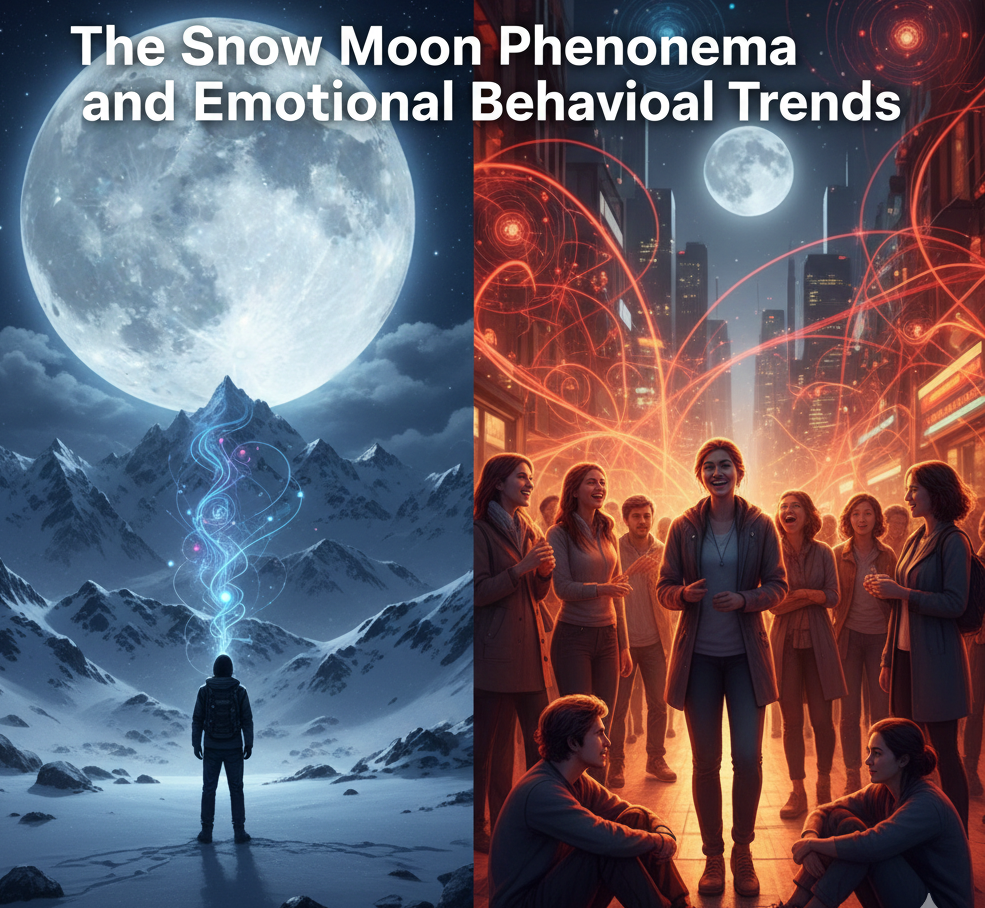
Every February, as winter begins to wane and the nights glow with silvery stillness, the Snow Moon rises — the second full moon of the year. Its name, rooted in Native American and European traditions, comes from the heavy snowfall typical of this time. But beyond its dazzling beauty, the Snow Moon has long been linked with deep emotions, introspection, and subtle shifts in human behavior.
In recent years, scientists, psychologists, and spiritual observers alike have begun to explore an intriguing question: Do lunar events like the Snow Moon really influence our moods and actions?
The Science Behind the Snow Moon
Astronomically speaking, the Snow Moon isn’t vastly different from any other full moon. It simply marks the February full moon, often shining brighter in the crisp, cold air. But because of its timing — at the cusp of winter’s end — it carries a powerful symbolic and emotional resonance.
Historically, communities viewed this moon as a sign of resilience and renewal. The harshness of winter would begin to ease, signaling hope and preparation for spring. Even today, many people report feeling heightened emotions, restlessness, or reflection around full moons, and the Snow Moon seems to magnify that effect.
While scientific studies on the “moon-mood connection” remain inconclusive, researchers have observed that sleep patterns, mood fluctuations, and even social behavior can subtly shift during full moons. Some experts attribute this to changes in light exposure affecting our circadian rhythms, while others see it as more of a psychological or symbolic influence — a reflection of how deeply humans are tied to natural cycles.
Emotional and Behavioral Patterns During the Snow Moon
The Snow Moon often coincides with a period of emotional transition. For many, it evokes feelings of cleansing, release, and self-assessment — a kind of emotional thaw after months of inner “winter.”
Common emotional themes people report during this period include:
Heightened sensitivity: A tendency to reflect more deeply on relationships, goals, and personal growth.
Restlessness or anxiety: The full moon’s brightness and cultural significance can make some people feel overstimulated or unsettled.
Renewed motivation: Just as nature prepares for spring, people often feel inspired to start fresh or make changes.
Social media trends also show spikes in conversations about self-care, healing, and mindfulness during the Snow Moon, suggesting that collective consciousness may amplify these emotions.
Cultural and Spiritual Perspectives
In many cultures, the Snow Moon is seen as a time for letting go of emotional weight and embracing transformation. Spiritual practitioners often hold full moon rituals — journaling, meditation, or symbolic cleansing — to align with its perceived energy.
Native American tribes viewed this moon as a reminder of endurance and gratitude amid scarcity. In modern spiritual circles, it’s often associated with emotional clarity — a light shining on what needs to change or heal.
Interestingly, even people who don’t identify as spiritual often report a sense of heightened awareness during this time, suggesting that ancient rhythms still echo in our subconscious.
The Psychology of Lunar Influence
From a psychological standpoint, the fascination with the Snow Moon reveals more about humans than the moon itself. The full moon acts as a mirror for emotion — a visual cue that encourages self-reflection. Its predictable rhythm offers a sense of cosmic connection in an otherwise chaotic world.
In times of stress or uncertainty, these natural markers can give structure and meaning. They remind us that cycles — both lunar and emotional — are normal. Just as the moon waxes and wanes, so do our moods, relationships, and motivations.
Finding Balance Under the Snow Moon
Whether one views the Snow Moon through a scientific, spiritual, or emotional lens, its presence invites a pause — a moment to breathe and reflect. Perhaps that’s why it continues to captivate people across cultures and generations.
As the Snow Moon rises this February, many will gaze at it and feel something they can’t quite explain — a quiet stirring, a nudge to let go, or a reminder that light always returns after darkness.
In the end, whether or not the moon truly alters our emotions, it certainly inspires us to look inward, to reconnect with nature, and to find calm amid life’s winter storms